You finish the job, the client pulls out a roll of bills and pays you in cash. No processing fee, no three-day wait for the transfer to land, and the money is already in your pocket. It feels like the cleanest way to get paid there is, and most of the time it is.
The problem with cash is not taking it. It is that above a certain amount it stops being a matter between two people and becomes something you have to report, and that amount is different in every country. Better to know where the line sits before a client walks you over it.
Cash did not die, it just got smaller
In May 2026 the Federal Reserve published its annual study of how Americans pay, with 2025 data: roughly one in seven payments is still made in cash. Some 76 percent of consumers were carrying bills on them, averaging 69 dollars in pocket, purse or wallet.
In other words, cash is no longer the main instrument, but it has not left anyone's till either. If you sell over a counter, collect at the customer's door or get paid on a job site, it is still a real part of your day, which is why the rules are worth knowing.
United States: ten thousand dollars and fifteen days
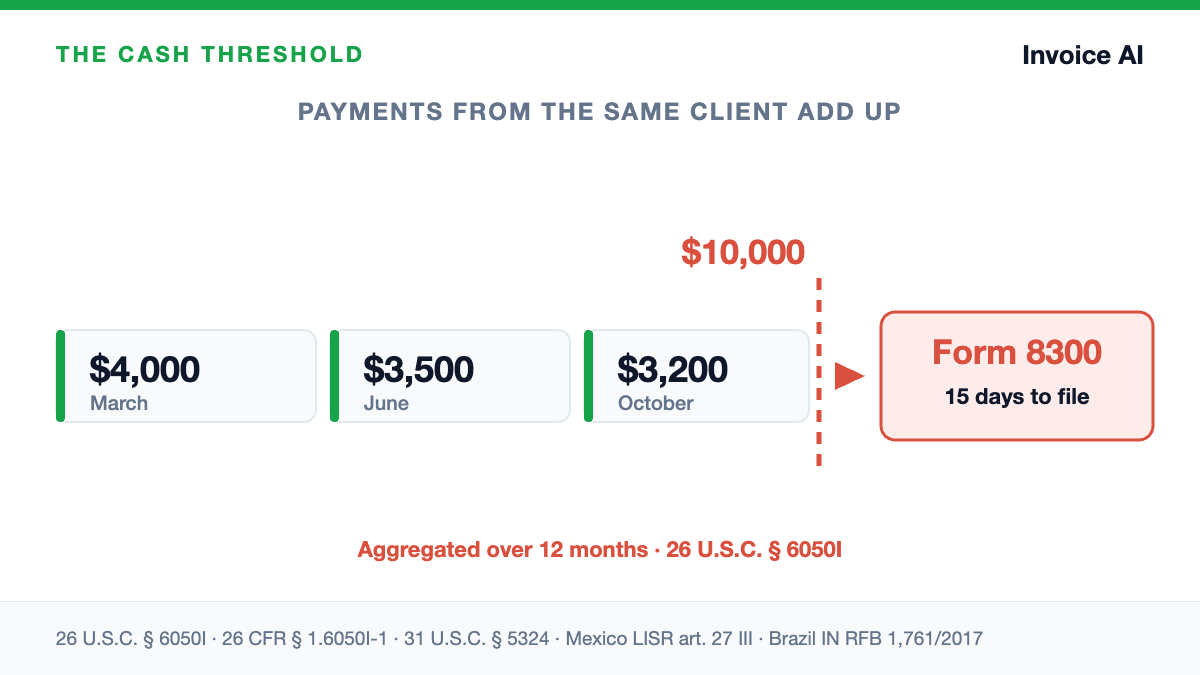
The federal rule lives in section 6050I of the Internal Revenue Code: anyone engaged in a trade or business who receives more than 10,000 dollars in cash in one transaction, or in two or more related transactions, has to file an information return. That is the familiar Form 8300.
The regulation that fleshes it out sets the clock: by the fifteenth day after the date the cash is received. This is not a year-end chore or something the accountant sorts out in April. Fifteen days from the moment the money hit your till.
And here is the part that catches people out: payments add up. If the first payment falls short of 10,000, it is aggregated with later payments from the same client within one year; the day the total goes over 10,000, those fifteen days start running. Yesterday's installment can trigger today's report.
Splitting the payment to stay under the line is a separate crime
The obvious dodge — "pay me nine thousand today and nine thousand next week" — is exactly what the law punishes on its own. Title 31, section 5324, forbids structuring transactions with one or more nonfinancial trades or businesses to evade that report, and it forbids assisting in structuring them too.
The penalty is not symbolic: a fine and up to five years in prison, and up to ten when it happens as part of a pattern of illegal activity involving more than 100,000 dollars in a twelve-month period. Reporting a large cash payment costs you nothing. Chopping it up to avoid reporting is what gets expensive.
Mexico: two thousand pesos before the expense stops counting
Mexico works on the paying end rather than the receiving end. Article 27 of the Income Tax Law requires, for an expense to be deductible, that it be backed by a tax receipt and that payments exceeding 2,000 pesos be made by electronic transfer, nominative check, card or authorized electronic wallet.
That low threshold explains a familiar scene: the business client who insists on wiring you the money even when you would rather have cash. It is not distrust. Above 2,000 pesos in bills, your invoice stops being useful to them as a deduction.
Separately, the anti-money-laundering law flatly bans settling certain deals in cash. Its article 32 covers real estate from 8,025 UMA and vehicles, watches, jewelry, precious metals and stones, works of art, armoring or shares from 3,210 UMA. With the 2026 UMA set by INEGI at 117.31 pesos a day, that is roughly 941,400 and 376,500 pesos.
Colombia: cash is valid, but not all of it counts
Article 771-5 of the Tax Statute is clear on the first point: the rule has tax effects only and does not question the validity of cash as legal tender with unlimited discharging power. Getting paid in bills is legal, full stop.
What it limits is how much of that cash is recognized as a cost or deduction. Since 2021 the cap is the lesser of two figures: 40 percent of what was paid, never above 40,000 UVT, and 35 percent of total costs and deductions. Anything beyond that does not exist for tax purposes.
And the second paragraph of the same article draws a line per transaction: individual payments above 100 UVT must be channeled through financial means, or they are not recognized as a cost, deduction, liability or creditable tax. There the size of each single payment matters as much as the yearly total.
Brazil: thirty thousand reais and a declaration of its own
Brazil does not forbid cash, it asks to be told. The Receita Federal created the DME, the declaration of transactions settled in cash, for operations of 30,000 reais or more, and it binds both individuals and companies, with financial institutions excepted.
The practical consequence is the same as in the United States: a large cash payment is not invisible, it is reportable. Failing to file it, or filing late or with omissions, carries a fine. Knowing that before you close the deal saves a surprise months later.
What you write down the day the cash comes in
- The real date of the payment, not the invoice date or a later deposit date.
- The exact amount in bills, kept apart from whatever came in by other means.
- Who paid: full name and ID, especially when the amount is large.
- Which invoice or quote it went against, by number.
- The receipt handed to the client, signed by you or by them on screen.
- The remaining balance, with its cut-off date, on the same document.
Six lines written the same day. None of the thresholds above can be worked out if cash shows up in your books as a loose amount with no client and no date, and that is precisely where almost everyone slips.
The sixty-second review
Before you put the money away: is the payment recorded with its date? Is it attached to a specific invoice? Does the client have a receipt? Do you know how much that same client has paid you in cash over the last twelve months? If the last answer is no, you are crossing the threshold blind.
This is information, not legal or tax advice. The rules cited change and apply differently by country and by case; check with a professional before deciding.
Sources
- 26 U.S.C. § 6050I and 26 CFR § 1.6050I-1 (15-day deadline and 12-month aggregation).
- 31 U.S.C. § 5324, structuring transactions.
- Federal Reserve, 2026 Diary of Consumer Payment Choice (2025 data).
- Mexico Income Tax Law, art. 27 III, and LFPIORPI, art. 32. 2026 UMA: 117.31 pesos a day.
- Colombian Tax Statute, art. 771-5.
- Receita Federal of Brazil, DME, IN RFB 1,761/2017.