You finished the job. You sent the invoice. Then, from one day to the next, the client stops answering the phone, the texts and the email. When he finally surfaces, he rarely says "I don't want to pay you." He says something more awkward: "who says it was done that way?"
At that moment the argument changes subject. It is no longer about whether you worked. It is about what you can show six months later, in front of somebody who wasn't there. And the law, in almost every country where you collect, puts that weight on the same side: yours.
The rule that decides the fight before it starts
This is not lawyer talk. It is written, in nearly the same words, across several separate codes. In Mexico, the Commercial Code, article 1194: whoever asserts is obliged to prove, so the plaintiff must prove his claim and the defendant his defenses (last amended in the DOF on 14 Nov 2025).
In Brazil, article 373, section I of the Code of Civil Procedure (Law 13.105 of 16 March 2015) puts the "fact constituting his right" on the claimant. In Colombia, article 167 of the General Procedural Code (Law 1564 of 2012) says the same thing differently: each party proves the facts behind the rule that favors it.
Translated: if you are claiming the money, you prove there was work, that it was delivered and when. The client does not have to prove he never got it. Staying quiet is enough. That is why the man who disappears is sometimes not running. He is waiting for your trail to fade.
This is general information, not legal or tax advice. Take any specific case to a professional in the country where you collect.
The five pieces that actually hold up
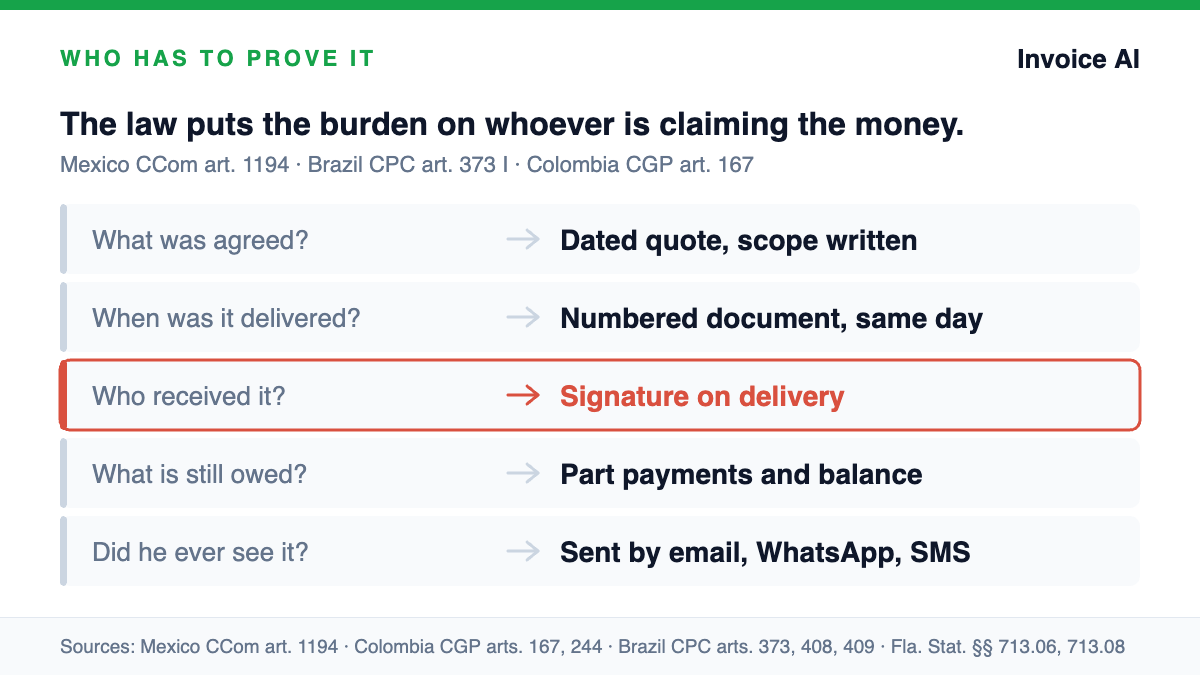
You do not need twenty documents. You need five, and all five appear on their own if you record things while you work instead of at the end.
1. What was agreed, before you started
A quote with the scope written out and dated. Not "paint the house": how many rooms, how many coats, whether you supply the materials. Most collection fights are not about the price. They are about what the price included.
An accepted quote turns a conversation into an agreement with edges. When "but I thought it also covered…" shows up later, the answer stops being your memory against his. It is a document dated before the work.
2. What was delivered, and on what day
The date is not decoration. Article 409 of the Brazilian code warns that if the date of a private document is questioned, that date has to be proven by other means. A numbered document, issued the day you delivered and sent that same afternoon, defends itself.
3. Who received it
This is the piece almost everybody skips, and the one that carries the most weight. The signature of whoever receives the work turns your document into evidence against him. Article 408 of the Brazilian code is blunt: what a signed private document states is presumed true as to the signer.
In Colombia, article 244 of the General Procedural Code presumes private documents from the parties authentic until somebody formally challenges them as false. Meaning: you do not start by proving the paper is real. The other side has to start by denying it.
4. What was paid and what is left
If there were partial payments, each one with its date and the balance that remained. A client who paid thirty percent down has already acknowledged the debt. Paying on account is hard to explain if the work supposedly never happened. That receipt outweighs three chasing emails.
5. Proof that you sent it
Sending the document through a channel that leaves a trace — email, WhatsApp, SMS — does not prove the work was done, but it proves he knew and said nothing for months. Long silence, with a start date on it, is an argument too.
Yes, a signature on a phone screen counts
It has been settled for more than twenty years. In the United States, the ESIGN Act (15 U.S.C. § 7001, Pub. L. 106-229, of 30 June 2000) bars denying legal effect to a signature or a contract "solely because it is in electronic form."
In Colombia, article 7 of Law 527 of 1999 treats the signature requirement as met when the method identifies the signer, shows approval and is reliable for the purpose. Article 247 of the procedural code adds that data messages are weighed as such, not as a photocopy.
In Mexico, article 93 of the Commercial Code treats written form and signature as met when the data message stays intact and is attributable to the parties; article 1298-A recognizes the data message as evidence. In Brazil, article 10 §2 of Provisional Measure 2.200-2, of 24 August 2001, accepts signatures outside ICP-Brasil when the parties accept them.
With one nuance worth knowing. That same article 408 clarifies that if a document states awareness of a fact, it proves the awareness, not the fact itself. Which is why a signature alone is not enough: it travels attached to what was delivered, when and for how much.
Evidence expires too
Keeping the paper is worthless if the deadline has passed. In Florida, anyone furnishing labor or materials on a construction job must notify the owner before starting, or no later than 45 days after starting (Fla. Stat. § 713.06(2)(a)).
And the lien on the property must be recorded no later than 90 days after the final furnishing of labor, services or materials (Fla. Stat. § 713.08(5)). Short windows, counted from the work, not from the day you get tired of calling.
The contractor who waits "a couple more months, see if he pays" is not losing patience. He is losing the right. And none of the five pieces gets written after the fact: a sheet created the day you decide to chase the money is worth far less than the same sheet created the day of the work.
What this looks like on an ordinary Tuesday
It is four minutes spread across the job: the quote before you start, the signature on the screen when you finish, the document sent that same afternoon and the partial payment logged the day it lands.
What proves nothing, however solid it feels: the verbal "we already agreed," the undated note in a pad, the photo of finished work with nothing tying it to that client and that day, and the chat you wiped when you changed phones.
The client who disappears is counting on you having lost half of that too. Whether he is right is not decided on the day of the dispute. It is decided on the day of the work.
Sources
- United States: 15 U.S.C. § 7001 (ESIGN, 2000) · Fla. Stat. § 713.06 and § 713.08.
- Colombia: Ley 527 de 1999 art. 7 · Ley 1564 de 2012 arts. 167, 244 and 247.
- Mexico: Código de Comercio arts. 93, 1194, 1205 and 1298-A (DOF 14-11-2025).
- Brazil: Lei 13.105/2015 arts. 373, 408 and 409 · MP 2.200-2/2001 art. 10.