You finished the job, you got paid, three months went by. The phone rings: the thing you fixed has failed again. The question is not whether you will go. The question is whether you are required to go, until when, and who decides that.
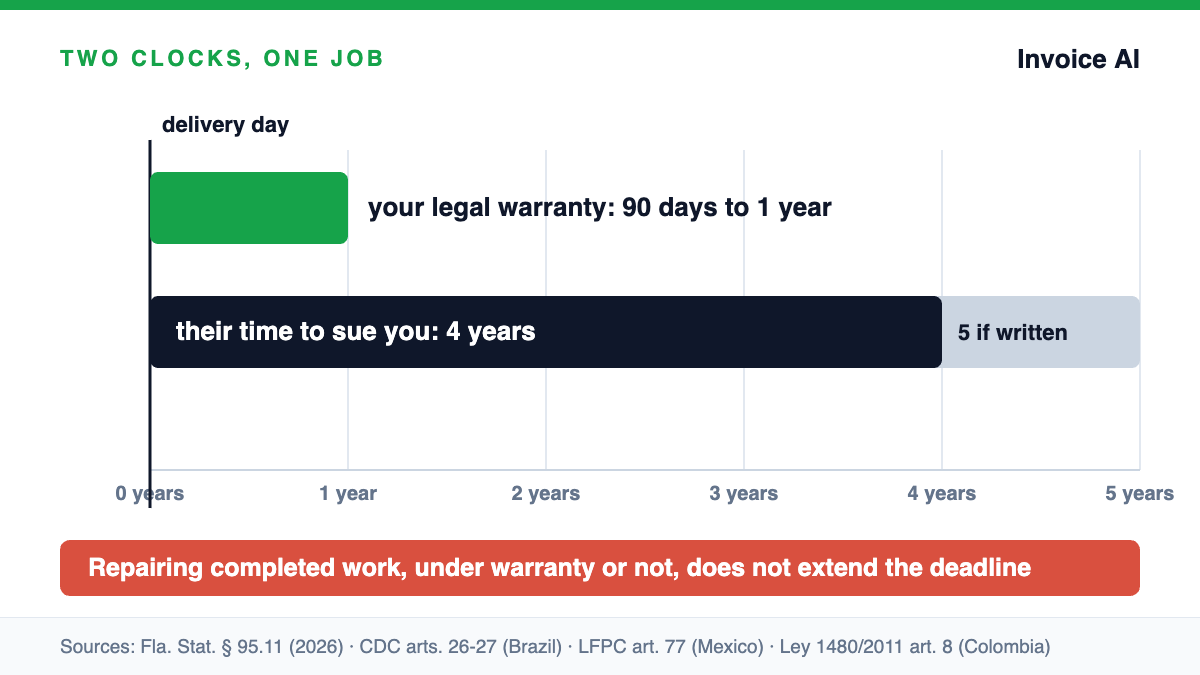
Most people assume the warranty is whatever they promised out loud. It is not. Two clocks are running at the same time: the warranty you gave, and the one the law puts on you even if you never wrote a single line about it.
The warranty you never wrote still exists
In the countries where this blog is read, the law sets a floor. You can offer more time, never less. And if you said nothing, it is not that there is no warranty: the legal one applies, with the term the law picked on your behalf.
- Colombia. If no term is stated, it is one year for new products. For services that involve handing back a good — a repair, for instance — the minimum is three months (Ley 1480 of 2011, art. 8).
- Mexico. Any good or service offered with a warranty carries a floor of ninety days from delivery of the good or performance of the service (LFPC, art. 77). It was sixty until the January 2018 amendment.
- Brazil. The right to complain about an apparent defect lapses in thirty days for non-durable services and products, and ninety days for durable ones (CDC, art. 26).
- Argentina. Six months for new movable goods and three for used ones, from delivery. And if defects in the work show up within thirty days of finishing a service, you fix them at no charge (Ley 24.240, arts. 11 and 23).
- United States. Florida sets no general warranty minimum, but it does set how long they have to sue you: five years on a written contract, four on an oral one or on the sale and delivery of goods (Fla. Stat. § 95.11).
The second clock: how long they can come after you
A warranty running out does not mean you are clear. They are two different things: one is your duty to come back and fix it; the other is the time your customer has to take you before a judge. The second one is almost always far longer.
Brazil spells it out. Ninety days to complain about the defect in a durable product, but five years to claim compensation for the damage that defect caused (CDC, arts. 26 and 27). Two clocks, and the second one runs twenty times longer than the first.
When the clock starts, which is rarely when you think
It does not start the day the estimate was signed, nor the day you were paid. It starts on the day of actual delivery of the good, or the day the service was completed. That is why the delivery date, written on the document, is worth as much as the price.
There is one exception that changes everything: the defect nobody could see. In Brazil, when a defect by its nature can only become known later, the clock starts the moment it becomes evident. Florida does the same with a latent construction defect: time runs from when it is discovered, or should have been discovered with due diligence.
Going back to fix it does not always reset the clock
This is where almost everyone gets it wrong, in both directions. Florida is blunt: correcting defects or repairing completed work, whether performed under warranty or otherwise, does not extend the period within which an action must be commenced. One more visit buys you no time.
Mexico says the opposite, in the customer's favour. If a repaired product shows defects attributable to whoever did the repair within ninety calendar days after it was handed back, it must be repaired again at no cost (LFPC, art. 81). Every repair opens a window of its own.
If you build, the scale is different
Construction changes the numbers completely. In Colombia, the legal warranty on a new building is ten years for structural stability and one year for finishes, and it cannot be contracted downward (Ley 1480, art. 8).
In Brazil, whoever carries out a substantial construction answers for five years for the soundness and safety of the work, and that term cannot be reduced; the owner then has one hundred and eighty days from the appearance of the defect to sue (Civil Code, art. 618).
In Florida, a claim founded on the design, planning or construction of an improvement to real property must be brought within four years of the certificate of occupancy or completion, and in no event after seven years (Fla. Stat. § 95.11(3)(b)).
What the law makes you put in writing
Several of these statutes do more than set deadlines: they require you to hand the warranty over on paper. In Mexico, the warranty policy must be issued in writing, clearly and precisely, stating scope, duration, conditions, how to claim and where, and it is given to the customer when they receive the good or service (LFPC, art. 78).
In Argentina, the warranty on a services contract must be documented in writing (Ley 24.240, art. 24). In Brazil, the contractual warranty is complementary to the legal one and is granted through a written instrument (CDC, art. 50).
The four lines that belong on the document
- What the job includes, in one sentence. Whatever is not written gets argued later, and argued expensively.
- The delivery or completion date, separate from the document date. That is where the clock starts.
- The warranty term and what it covers: labour, parts or both. Leave it out and the legal minimum applies, not the one in your head.
- What voids it: third-party tampering, use other than intended, missed maintenance. Only what the law allows you to exclude, which is not everything.
And a fifth item that is not a line: the customer's signature on receipt. It is what turns "I dropped it off on the twelfth" into a fact with a date. An invoice signed on the phone screen, with its PDF saved and sent, does that job without a filing cabinet.
The file that gets you out of it
When the argument arrives, it is rarely won by being right: it is won with paperwork. Three pieces are enough. The accepted estimate, which says what you committed to. The invoice with a delivery date and a signature. And a record of every later visit, with what you found and what you did.
This is general information, not legal advice for your situation. The rules cited are consumer protection rules and apply to consumer transactions; business-to-business work is governed by other rules, where the contract carries more weight.
Sources
- The 2026 Florida Statutes, § 95.11 (limitations of actions) and § 672.314 (implied warranty of merchantability).
- Colombia, Ley 1480 de 2011, arts. 7, 8 and 11.
- Mexico, Ley Federal de Protección al Consumidor, arts. 77, 78 and 81 (last amended DOF 12-12-2025).
- Brazil, Código de Defesa do Consumidor, arts. 26, 27 and 50, and Civil Code, art. 618.
- Argentina, Ley 24.240, arts. 11, 23 and 24.