You send the quote, the client takes four days to answer and comes back with "what if we drop this part?" The price wasn't wrong. The problem is that the paper you sent closed nothing: it didn't say how long it was good for, what was included, or what happens when something changes.
A quote done right is not a price on letterhead. It is an offer with a date, a scope and a stated way to accept it. That difference decides whether you get a "go ahead" or a fresh negotiation every time the client remembers you exist.
Your quote is already an offer, whether you know it or not
In Colombia, article 845 of the Commercial Code defines an offer as the draft transaction one person puts to another, and it demands two things: that it contain the essential elements of the deal and that it be communicated to the recipient. Without those two ingredients, what you sent is a loose number.
Article 846 goes further: the proposal is irrevocable. Once communicated, the offeror cannot pull back without compensating the damage caused. In Brazil, article 427 of the Civil Code says it in one line: the proposal binds the offeror, unless its own terms say otherwise.
In Mexico, article 1804 of the Federal Civil Code ties it to the deadline: whoever proposes a contract and sets a period to accept stays bound by the offer until that period expires. Your quote commits you first. That is exactly why it should be written as if it were going to be collected.
The line almost nobody writes: how long it's good for
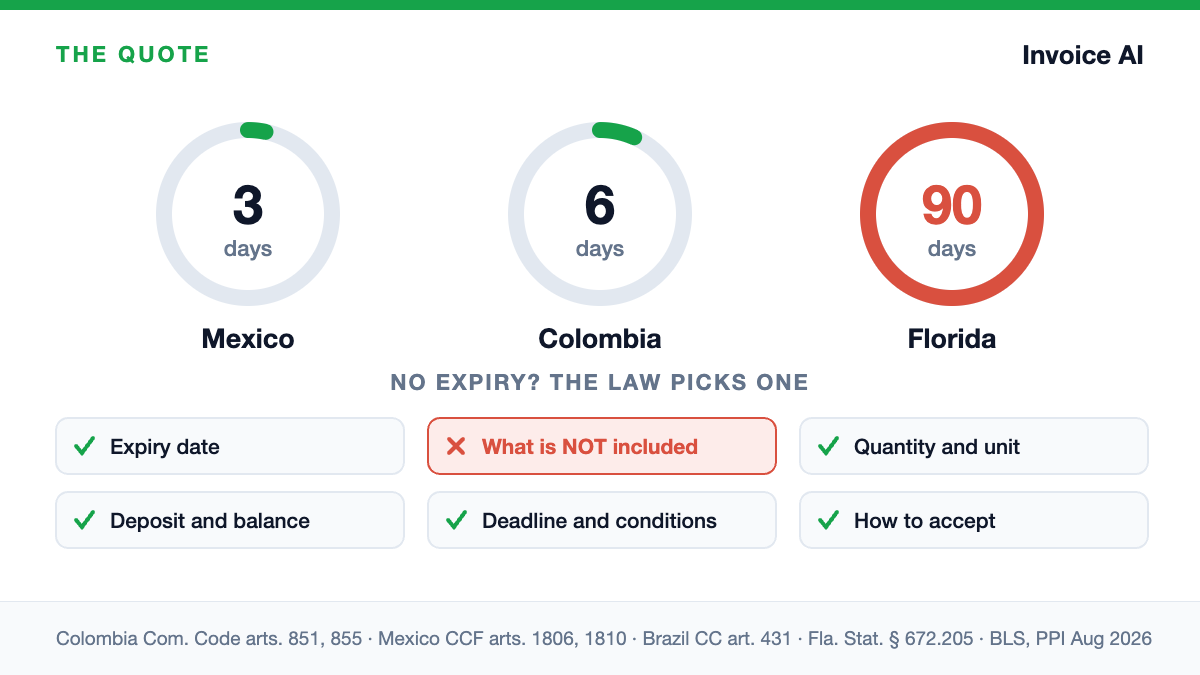
If you set no expiry, the law sets one for you, and you may not like it. In Mexico, an offer with no deadline made to an absent person binds its author for three days, plus regular mail time (art. 1806). In Colombia, a written proposal must be accepted or rejected within six days of its date (art. 851).
In Florida, a merchant's signed firm offer is not revocable during the time stated; if no time is stated, for a reasonable time, and in no event beyond three months (Fla. Stat. § 672.205). Three different clocks in three countries. Writing "valid for 15 days" takes you out of that lottery.
There is a money reason too, not just a legal one. In the United States, the producer price index for processed goods for intermediate demand — inputs and materials — rose 11.5 percent in the twelve months ended August 2026, per the Bureau of Labor Statistics. A price from six weeks ago is not today's price.
The six lines that hold up a yes
1. What is in and what is out
Scope gets written in two columns. What it includes, with verbs: install, two coats of paint, haul away the debris. And what it does not include: permits, scaffolding, exterior paint, after-hours labor. The second column is the one that prevents the argument, because it kills "I assumed that was covered."
2. Quantities and units
"Interior painting" is not a quantity. "880 sq ft of wall, two coats" is. The unit — foot, hour, piece, trip — turns the price into something checkable and gives you the base to requote without fighting: if twenty more feet show up, the client already knows what each one costs.
3. The price, opened line by line
A single total invites haggling over the total. A line-by-line breakdown, with its tax and its discount where they belong, moves the conversation toward "let's drop line 4." That is not losing. That is closing smaller and faster, with the margin intact on everything that stays in.
4. When it gets paid
Deposit, balance and payment method, written on the same sheet. If there is material you are fronting, say so, and say it with a number. A client who accepts a quote with a 40 percent deposit is not surprised when you ask for 40 percent; one who accepted a bare price will be.
5. Delivery time, and what it depends on
"Ten business days counted from the deposit and from key handover" says far more than "ten days." A deadline with a condition protects you from the delay you did not cause, which is most delays, and it also teaches the client what their own part of the job is.
6. How it gets accepted
Say it inside the quote: sign here, or reply to this email with the word "approved." An on-screen signature and a date matter because they pin down a moment. With no stated way to accept, acceptance arrives as a voice note nobody remembers in March.
When the client "accepts" with changes
Worth knowing before it happens. In Colombia, a conditional or late acceptance counts as a new proposal (art. 855). In Mexico, if the reply is not plain and unqualified but modifies the offer, the offeror is released and that reply is treated as a new proposal (art. 1810).
In Brazil, article 431 of the Civil Code says acceptance out of time, with additions, restrictions or changes, amounts to a new proposal. Florida runs the other way for goods between merchants: added terms can become part of the contract unless the offer limits acceptance or the terms materially alter it (§ 672.207).
Translated to the job site: "I'll take this, but not that" is not a yes. It is a new quote, and you decide whether to sign it. Issuing version 2, with its own number and its own date, costs two minutes and hands you back control of the price.
From yes to invoice, without retyping it all
An accepted quote has to become an invoice with the same numbers. Retyping is where lines go missing and prices nobody agreed to show up. And if every quote carries a status — sent, accepted, expired — you know which one to chase today and which one is no longer worth the call.
The sixty-second review
- Does it have an issue date and an expiry date?
- Does it say what it does not include?
- Does every line have quantity, unit and price?
- Does it say how much is paid up front, and when the rest?
- Does the delivery time depend on something, and is that written down?
- Does it say how to accept and where to sign?
Six questions. The one you leave unanswered is exactly the one the client will use to renegotiate. Answer them before the quote goes out and the next conversation will be about when you start, not about what it costs.
This is information, not legal or tax advice. The rules cited change and apply differently by country and by case; check with a professional before deciding.
Sources
- Commercial Code of Colombia, arts. 845, 846, 851 and 855.
- Federal Civil Code of Mexico, arts. 1804, 1806 and 1810 (last amended DOF 14-11-2025).
- Civil Code of Brazil, arts. 427 and 431.
- Fla. Stat. § 672.205 and § 672.207.
- U.S. Bureau of Labor Statistics, Producer Price Indexes, August 2026 (Sep 10, 2026).