The client owed you 1,000 and wired 300. You send back a "got it, thanks" and get on with the day. Three months later, when you argue about the balance, neither of you wrote down what those 300 paid off, and the client swears it came off the principal.
The partial payment is the most neglected moment in a collection: money arrives, you say thank you, nothing gets written. The law does have an answer, and in four countries across the hemisphere it is the same one, and it is not what most people assume.
What a partial payment pays first is not the debt
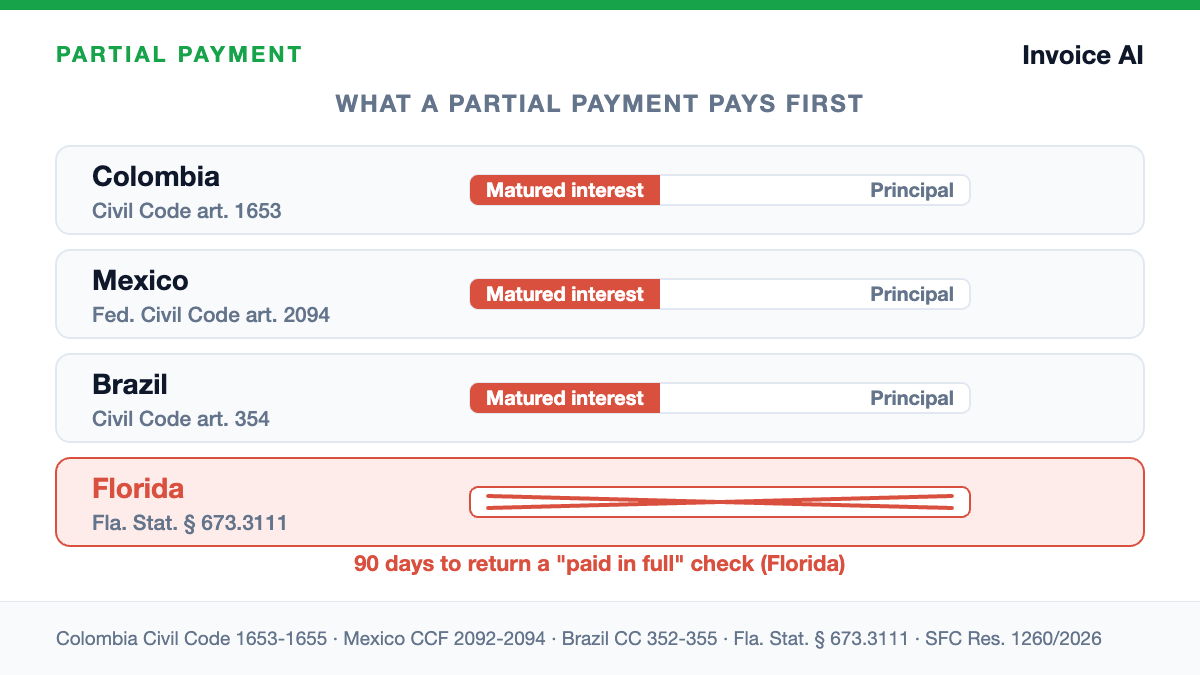
In Colombia, article 1653 of the Civil Code puts it flatly: where principal and interest are both owed, payment is applied to the interest first, unless the creditor expressly consents to apply it to the principal. Interest comes first. The principal sits untouched until the interest is covered.
In Mexico, article 2094 of the Federal Civil Code says the same thing from the other side: amounts paid against debts bearing interest shall not be applied to the principal while there is matured, unpaid interest, absent an agreement to the contrary. In Brazil, article 354 of the Civil Code repeats the rule almost word for word.
This is not banker's small print. If your invoice carried agreed late interest and the client pays part of it, that money paid the late interest first: the real balance is bigger than plain subtraction suggests, and the client believes the opposite.
The receipt that can cost you the rest
Here is the trap. That same article 1653 adds a second paragraph: if the creditor issues a receipt for the principal without mentioning the interest, the interest is presumed paid. A badly written receipt hands the client the interest on the entire debt.
In Brazil, article 354 leaves the same door open: the interest-first rule breaks if the creditor issues the receipt on account of principal. And article 353 shuts the door from the other side: if the debtor did not state which debt the payment goes to and accepted a receipt for one of them, he cannot later complain about the creditor's allocation.
Translated: the paper you write is what decides. "Payment toward principal" is a sentence worth money. "Payment on invoice 1042: late interest first, remainder to principal" is a different sentence, worth different money. The gap between them is two lines written on the day the money arrives.
When the client owes you several invoices
The most common case in the trade: three open invoices from the same client and one deposit with no explanation. Which one did it kill? The law hands out the right to choose, and it hands it out in order.
In Colombia, article 1654 gives the debtor the first word: he may apply the payment to whichever debt he chooses, but without your consent he cannot prefer a debt not yet due over one already due. If he says nothing, you may allocate it in the receipt; and if he accepts that receipt, he is not free to complain afterwards.
In Mexico, article 2092 lets him declare which debt the payment applies to at the time he pays. If he does not, article 2093 decides for both of you: the payment is deemed made on the most onerous of the matured debts; all else being equal, on the oldest; and if all bear the same date, it is split pro rata among them.
In Brazil, articles 352 and 355 follow the same shape: the debtor names which of the liquidated, matured debts he is paying, and if he names none and the receipt is silent, the payment goes to the liquidated and matured ones first; if all of them are, to the most onerous.
The check that says "paid in full"
The United States has a sharper version of the same problem. In Florida, section 673.3111 of the Statutes provides that if the debtor tenders in good faith an instrument carrying a conspicuous statement that it is in full satisfaction of a disputed claim, and you cash it, the claim is discharged. All of it.
Subsection (3) leaves two ways out. One is having given conspicuous written notice of the address for communications about disputed debts. The other is repaying the amount within ninety days after payment of the instrument. Ninety days, and that is that.
So that check for less than you are owed, with "paid in full" written on the back, is not a partial payment: it is an offer to close. Reading the back before you deposit it costs five seconds.
What the interest actually weighs
Worth putting a number on it. In Colombia, the financial regulator certified the current bank interest rate for consumer and ordinary credit at 19.49 percent effective annual for September 2026 (Resolution 1260 of August 31, 2026).
And article 884 of the Commercial Code says that where the parties did not stipulate late interest, it runs at one and a half times the current bank rate: with the September figure, about 29.2 percent effective annual. On a balance of 1,000 in arrears, that is more than 24 a month the payment eats before it touches the principal.
Mexico runs on a different scale: article 362 of the Commercial Code sets that a debtor who delays payment owes the agreed interest and, failing that, six percent a year. Same allocation rule, very different weight. Which is why putting the interest in writing changes the outcome as much as the rule itself does.
How to record a partial payment and end the argument
- Write the receipt the same day, even when the money came by transfer.
- Name the invoice: number and date, not "the job at the house".
- State the order: interest first, or principal if that is what you agreed.
- Put the new balance on the same paper, with its cut-off date.
- If several invoices are open, say which one it went to and how much to each.
- Send the receipt to the client and file your copy with the bank record.
Six lines. The partial payment stops being a mystery and becomes a document, which is the only thing that helps when the client remembers the figure backwards.
The sixty-second review
Before you put the phone away: is it written down which invoice the payment went to? Does it say interest or principal? Is the remaining balance on paper? Does the client have a copy? If any answer is no, you are the one who loses the argument in March.
This is information, not legal or tax advice. The rules cited change and apply differently by country and by case; check with a professional before deciding.
Sources
- Civil Code of Colombia, arts. 1653, 1654 and 1655.
- Commercial Code of Colombia, art. 884.
- Federal Civil Code of Mexico, arts. 2092, 2093 and 2094, and Commercial Code, art. 362 (DOF 14-11-2025).
- Civil Code of Brazil, arts. 352, 353, 354 and 355.
- Fla. Stat. § 673.3111.
- Superintendencia Financiera de Colombia, Resolution 1260 of Aug 31, 2026, bank interest rate in force for September 2026.